
Web design & development
Websites built to work. Designed to feel yours. Made to move people.
Branditify is a web development company. We design and build custom business websites around what you need to communicate, what a customer needs to understand, how the brand should feel, what search needs to find and what a visitor should do next.
Illustrative website · sample content
Before the design
Before a page is designed, it needs a job.
Most websites go wrong here rather than in the visuals. A short brief becomes a set of questions, the questions become pages, and the pages become one route a customer can actually walk.
A business website works best when every important customer question has a page or section that owns it. The structure should let somebody understand what the business offers, decide whether to trust it, and know what to do next — so planning starts from the questions customers actually arrive with rather than from a list of pages.
- Business
- A physiotherapy practice
- Audience
- People looking for treatment now
- Services
- Assessment, sports injury, rehabilitation
- Proof
- Chartered practitioners, one clinic
- Action
- Book an assessment
- HomeWhat this is, and the one action
- TreatmentsWhat we treat, and for whom
- TeamWho you would see
- FeesWhat it costs, before they ask
- ContactBook, or speak to somebody
- Home
- Treatments
- Team
- Fees
- Contact
Five pages that each own a question beat fifteen pages that repeat each other. It is also the structure search engines and answer engines read most easily, so the same decision serves the customer and the crawler.
The page system
One system, every page. Not fifteen bespoke layouts.
A website is built from a small set of decisions applied consistently. That is what makes a site feel designed rather than assembled, and what makes it possible to add a page next year without it looking foreign.
A custom website is built on a design system: one type scale, one spacing rhythm, one set of section patterns, one way images are treated and one way actions look. Every page is composed from those decisions, so the site stays coherent as it grows and anyone adding a page later has something to follow.
- Hero — headline and one action
- Three treatments
- Proof
- Booking
- What we treat
- Detail per condition
- What an appointment involves
- Booking
- Who you would see
- Qualifications
- How to ask for someone
- Booking
- Book
- Call
- Where we are
- When we are open
The system is built for the site it belongs to. It is not a component library bought in and re-skinned — that is how sites end up looking like everybody else who bought the same one.
Every screen
The phone is not the desktop, made smaller.
Responsive design is a series of decisions about what matters most at each width. Shrinking is what happens when nobody made them.
A responsive website recomposes rather than scales. At each width the order of content, the navigation and the emphasis are decided deliberately — on a phone the thing most people came for moves to the top, the menu goes behind a button, and anything that only made sense as a wide two-column layout is rebuilt rather than squeezed.
- 01Headline and action
- 02Treatments beside it
- 03Proof
- 04Booking
There is room to show the offer and the proof at the same time, so both are visible without scrolling.
- 01Headline and action
- 02Treatments
- 03Proof
- 04Booking
The two columns become one. Nothing is dropped, but the reading order now has to carry the argument on its own.
- 01Headline
- 02Book — pinned
- 03Treatments
- 04Proof
Most people arriving on a phone are in pain and want an appointment. So booking moves up, and the rest follows.
The order on a phone is a business decision more than a design one. We make it with you rather than letting the desktop layout fall over into whatever shape it lands in.
Saying something
Most websites are well-built and say nothing.
The build is rarely the problem. The problem is a page that could belong to any of four hundred businesses in the same category.
A website communicates through its words as much as its design. A generic page states a category and a promise anybody could make; a brand-led page names the specific person it is for, the problem they have and the reason to believe it can be solved — with proof positioned next to the claim rather than on a separate page.
The first version tells you the name of a place. The second tells you it understands why you are here.
Two facts beat one adjective. Both are checkable, which is what makes them worth reading.
Proof works where the doubt happens. Nobody clicks through to be reassured.
“Learn more” asks for another decision. The real action asks for the one they came to make.
We write with you rather than for you. What you know about your customers is the raw material, and it is usually sitting in the questions your team answers on the phone every week.
How a brand gets decidedHow it is built
Rich and fast are not opposites.
A slow site is usually a series of small decisions nobody made. These are the ones that matter, and they are all decided during the build rather than repaired afterwards.
A visually rich website can still be fast. Speed comes from decisions made during the build: images sized and served for the screen requesting them, fonts loaded so text appears immediately, space reserved for anything that arrives late so the layout never jumps, motion kept to properties the browser can animate cheaply, and semantic HTML underneath it all.
We do not publish scores for a site that does not exist yet. What we can say is which decisions produce a fast site, and that they are made while it is being built rather than audited afterwards.
Found, not optimised later
The structure that helps a person is the structure that gets read.
Search is not a layer applied at the end. It is mostly the same work as making a site clear — one page owning one question, said plainly, linked properly.
Search visibility is designed into a website rather than added afterwards. Each page owns one question a person actually asks, answers it in the first paragraph, carries a title and description written for that question, and links to the pages that answer the next one. The structure that makes a site easy for a person to use is largely the structure a search engine reads.
Building a site this way is the foundation, not the whole job. Competing for a term over time is continuing work, and it lives on the SEO, AEO and GEO page rather than being implied here.
Ongoing search and answer visibilityWhich one you need
A website explains. An application does work.
Most agencies in this category sell both under one heading. They are different projects with different costs, and knowing which one you need is the most useful thing to settle early.
A website exists to communicate: it explains what a business does, builds enough trust to act, and captures an enquiry or a booking. A web application contains software logic — user accounts, records, permissions and workflows people work inside. Many businesses need a website now and an application later, and they are usually better built as separate projects than as one blurred brief.
The job is to explain, persuade and capture the enquiry.
- People need to understand what you do and decide to contact you
- The content changes occasionally, not constantly
- Forms send an enquiry, a booking request or a download
- Nobody logs in to do a job of work
- Being found in search matters to the business
The job is to hold records and run a process.
- People sign in and do something repeatedly
- There are records — customers, orders, cases, learners
- Different people are allowed to see and do different things
- A process has states, and moving between them is the point
- It has to connect to systems you already run
If it turns out you need both, we will say which one to build first. A website that generates enquiries usually earns the application, and the reverse rarely works.
What decides the size
Scope is set by the content and the behaviour.
Page count is the least useful way to size a website project. These are what actually move the work.
The size of a website project is decided mainly by how many genuinely different page types it needs, how much content exists and what state it is in, how much bespoke design each page requires, whether the client needs to edit it themselves, what has to connect to other systems, and whether an existing site is being migrated with its URLs preserved.
Not page count — how many genuinely different layouts
Written and approved, or still to be written with you
Composed from the system, or individually art-directed
A CMS your team uses, and how much it must let them change
Forms into a CRM or inbox, booking, payments, analytics
Moving an existing site while keeping its URLs and search history
How much of it moves, and how carefully
One audience, or several with different content
Delivery time follows the same drivers, and the one that moves it most is content. A project with the words already written runs to a different rhythm from one where they are being decided as we go — which is normal, and better planned for than discovered.
Selected work
Sites we designed and built.
Judge the layout thinking, the typography and the way these hold up on a phone. Each project lists the work its own record states — nothing is described as more than it was.


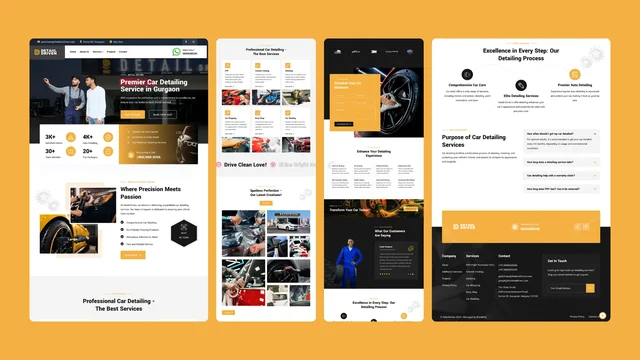

Scope shown per project is taken from that project’s own record. Where a project was design-led rather than a full build, its listed services say so.
Questions
Asked before commissioning a site.
- What does a web development company actually do?
- It turns a business brief into a working website: deciding what pages are needed and what each one is for, designing how the site looks and behaves, writing or shaping the content with you, building it so it works on every screen, and connecting the forms and tools it needs. A good one also thinks about how the site will be found and how it will be edited after launch.
- What is included in custom website development?
- Structure and page planning, design of a system the whole site is built from, the build itself, responsive behaviour at every width, content shaping, forms and their connections, a CMS where you need one, and the search groundwork — headings, titles, descriptions and internal links. Exactly what is included is agreed in scope rather than assumed from a package.
- What is the difference between web design and web development?
- Design decides what the site looks like and how it behaves — layout, type, colour, structure and interaction. Development builds that so it works: responsive, fast, accessible, connected to whatever it needs and editable afterwards. They are two halves of one job, and separating them across two suppliers is where most of the friction in website projects comes from.
- What is the difference between a website and a web application?
- A website communicates: it explains what you do, builds enough trust to act, and captures an enquiry or booking. A web application contains software logic — accounts, records, permissions and workflows people work inside. If people sign in and do a job of work, that is an application, and it belongs on the custom software page rather than being quietly folded into a website quote.
- Can Branditify redesign our existing website?
- Yes, and it is often the better project. We start by looking at what is already working — the pages that get traffic, the content worth keeping, the parts your team actually uses — then rebuild around that rather than starting from an empty page. A redesign that discards a site’s history is usually a step backwards.
- Can we keep our current URLs and content?
- Where they are worth keeping, yes. URLs that already have search history are preserved wherever the new structure allows, and anything that has to change is redirected properly so the history follows it. Content is reviewed rather than dumped — some of it is fine, some needs rewriting, and some should not survive the move.
- Will the site work properly on mobile?
- It is designed for a phone as deliberately as for a desktop, which means recomposing rather than shrinking. The order of content changes, the navigation changes, and whatever most people arrived to do moves to the top. That order is a business decision we make with you.
- Is SEO considered during development, or added afterwards?
- During. The structure that makes a site clear to a person is largely the structure a search engine reads — one page owning one question, answered near the top, with real headings and sensible internal links. Titles, descriptions and structured data are written as part of the build. Competing for a term over time is separate ongoing work.
- Can the website have a CMS so we can edit it ourselves?
- Yes, and we scope it around what you actually need to change. A CMS that exposes everything is how a carefully designed site slowly stops looking designed, so we usually give your team real control over the things that change often and leave the structural decisions alone.
- Can our team manage content after launch without a developer?
- That is the intention. Adding a page, changing text, swapping an image or updating opening hours should not need us. We hand over with the site set up for the people who will run it, and we would rather spend an hour showing your team than have them wait on us for a typo.
- Can forms connect to our CRM or other tools?
- Where the tool allows it. Enquiries can go to an inbox, a CRM, a spreadsheet or a booking system, and we confirm what each one can genuinely accept before designing around it. Where nothing suitable exists, the simplest reliable option is usually the right one.
- Can you build animation and interaction without making it slow?
- Yes, by being deliberate about what moves. Motion kept to properties a browser handles cheaply is close to free; the expensive kind is usually decorative. Everything we build also has a reduced-motion state, because a meaningful proportion of people have asked their device not to animate things.
- Can a visually rich website still be fast?
- Yes. Speed comes from decisions made during the build rather than repairs made afterwards: images sized for the screen requesting them, fonts loaded so text appears immediately, space reserved for anything arriving late so the layout does not jump, and content that renders with the page rather than after JavaScript. Rich and fast are not opposites; rich and careless is what causes the problem.
- Do you migrate existing websites?
- Yes. We audit what is there, decide what moves and what is retired, preserve the URLs worth preserving, redirect the rest, and check the result against the old site before it goes live. Where content lives in a platform that exports badly, we find that out early because it changes the plan.
- Who owns the website, the code and the content?
- You do. The design, the code and the content are yours, handed over as agreed in scope, along with the accounts they run on. There is no Branditify platform to stay subscribed to and no licence to renew.
- What determines the scope of a website project?
- Mainly how many genuinely different page types are needed, how much content exists and what state it is in, how bespoke each page has to be, whether you need to edit it yourselves, what it connects to, and whether an existing site is being migrated. Page count on its own tells you very little.
- What affects how long it takes?
- The same drivers, and content moves it most. A project with the words already written runs to a different rhythm from one where they are being decided as we go — which is completely normal, and much better planned for than discovered halfway through.
- What makes a website project expensive or complicated?
- Usually content and bespoke design. A site where every page is individually art-directed and the words are still being written is a bigger job than one composed from a strong system with copy ready. After that it is integrations and migration, because both depend on systems we do not control.
- How does a project start?
- With the five questions the site has to answer: who you are, what you offer, who needs it, what they have to believe, and what they should do next. That produces a structure. From there we can be specific about what the project involves rather than quoting against a page count.
Start here
Bring us the site you have, or the brief you have not written yet.
Either is a fine place to start. A short conversation about who the site is for and what it has to make happen usually settles the shape of the project.