
Branditify

Branditify for law firms

Law firm website design, and the system behind the enquiry.

Someone with one problem is deciding whether your firm is the firm for it. They are reading a practice-area page and a lawyer profile, and then they are writing to you. Branditify builds that experience — and, where a firm wants it, the intake, matter record and client access the enquiry moves into next.

Branditify is a digital studio. We are not a legal practice-management product, we do not provide legal advice, and we do not advise on what a firm’s regulator permits it to publish.

File M-2431Commercial disputesOwned
Nandi & RaoBengaluru

The client can see the status the firm has chosen to publish.

What the client seesStage, the documents shared with them, and one place to reply.
What the firm knowsOne thread instead of the same question asked four ways.
Who has itS. Rao · Disputes
Next actionAwaiting client documents.

An illustrative file. No client, matter or outcome on this page is real.

Systems a firm can operate

Four, not fourteen.

Branditify builds more systems than these. These are the ones that change something for a law firm — each is linked to its own page, where it is described as the general system it is.

Lead system · client-facing

Client Portal

Clients ring to ask where a matter has reached, what is needed from them, and where a document went.

One structured place for the matter status the firm has chosen to publish, the documents shared in each direction, what is still outstanding, and a single thread to reply on.

The status call stops being a call.

It publishes only what the firm decides to publish, and it never gives advice about the matter.

Client Portal
System · enquiry and matter record

CRM

Enquiries arrive by form, phone and referral, and nobody can say who has them.

Every enquiry becomes one record carrying a source, a practice, an owner and a next action — and the matter relationship that follows it.

The firm can answer questions about its own intake.

It does not perform conflict analysis and does not decide whether to take a matter.

CRM
System · internal retrieval

RAG Knowledge Base

The answer exists in a document somebody wrote two years ago, and nobody can find it.

Retrieval over the know-how the firm has approved for reuse — precedents, templates, internal process notes — answered with the source it came from.

The firm’s own people stop rebuilding what already exists.

It does not generate advice or drafting, and it is never exposed to the public site.

RAG Knowledge Base
System · website intake

AI Chatbot

Somebody arrives at eleven at night with a question the website already answers.

A website assistant scoped to the firm’s published pages, which answers what is on them and hands anything beyond them to a person, taking the intake on the way.

The enquiry is captured instead of lost to the morning.

It does not answer legal questions and does not present itself as a lawyer.

AI Chatbot

Not every firm needs all four. Most firms that start here start with the website and the enquiry path, and add a system when a real bottleneck justifies it.

What Branditify does

The work, described for a law firm.

Each of these is a full service in its own right, and its own page explains it in general terms. What is below is what it means when the client is a firm.

Service · design and build

Law firm websites

One Services page listing eleven practices tells a prospective client nothing about their own problem.

Practice-area architecture, lawyer profiles that carry qualifications and practices, an enquiry path shaped per practice, and the firm’s own disclaimers built into the structure rather than added at the end.

A visitor can tell within a minute whether the firm handles their matter.

Service · structure and discovery

Search and answer-engine work

People search their problem, not the firm — and no page on the site answers the problem.

Structuring practice pages around the questions people actually type, so a page exists that answers the matter rather than describing the firm.

The right page is the one that can answer the question.

No position in any result is promised.

Search and answer-engine work
Service · writing and structure

Content

The firm’s expertise is real and the website describes it in two generic sentences.

Practice-area explanations, advocate profiles and insight writing, built from the firm’s approved positions and reviewed by the firm before anything publishes.

What the firm knows becomes something a client can read.

Service · brand system

Identity

The firm reads as older, smaller or less distinct than it is, and every document says something different.

Where a firm is new, merging, or presenting itself in a way that no longer matches how it practises — a mark, a type system and the restraint to use it seriously.

One firm, recognisable across every surface a client sees.

The first two minutes

A client is not comparing firms. They are checking whether you do this.

Legal work arrives as one specific problem. Before anybody compares firms they are answering a much narrower question, and most firm websites answer it slowly.

Does this firm handle my problem?

What is there todayA single Services or Practice Areas page listing eleven areas in a column, each a line long.The prospective client, in the first thirty seconds.
What it costsThey cannot tell whether a shareholder dispute is something the firm actually runs, so they go and check somebody else.
What replaces itOne page per practice the firm genuinely wants, written to answer that practice’s own questions.Premium Websites

Who would I be speaking to?

What is there todayA team grid of photographs with a designation under each, and nothing else.The client, and the partner whose credentials are invisible.
What it costsSeniority and depth are the reason to instruct the firm, and the site withholds exactly that.
What replaces itA profile per lawyer the firm wants known — qualifications, enrolment, practices, and the writing that shows how they think.Content

How do I actually reach them?

What is there todayA contact form with Name, Email, Message — the same form a shoe shop uses.Whoever opens the inbox in the morning.
What it costsThe firm learns nothing before the first call, and the client repeats their story twice.
What replaces itAn enquiry path shaped by practice, asking for what the firm needs before it can assess the matter.CRM

Search, practice, enquiry

People do not search for law firms. They search for their problem.

The query is the matter, in the client’s own words. Whether a firm appears depends on whether a page exists that answers that question honestly — and the general Services page almost never is that page.

notice received for a contract breach — what happens next

Practice page · Commercial disputes
  • What the process actually looks like
  • What the firm needs to see first
  • Who leads the practice

trademark opposition filed against my brand

Practice page · Intellectual property
  • What is at stake and on what timeline
  • What the firm needs from you
  • Who has run these before

shareholder dispute lawyer in bengaluru

Practice page + seat
  • That the firm runs these matters
  • Where the firm practises
  • A way to enquire that fits the matter

Should a law firm publish separate pages for each practice area?

Yes, for the practices the firm actually wants work in. A practice-area page can answer the questions that practice’s clients ask, name the people who lead it, and carry an enquiry path shaped for that matter — none of which a combined Services list can do. Practices the firm does not want more of do not need a page.

Nobody can promise a position in search results, and this page does not. What is buildable is the page that deserves to answer the question.

Practice-area architecture

Each practice has its own client, its own question and its own intake.

This is why one Services page cannot carry a firm. The questions below are different questions, and the information a firm needs before it can respond is different information.

Litigation & disputes

What the client is askingI have received a notice. What happens now?
What the practice page carriesForums the firm appears before, how a matter typically proceeds, and what the first weeks involve.
What the enquiry asks forCounterparty, what has been served, any dates already running, jurisdiction.

Does a law firm need separate profile pages for each lawyer?

For the lawyers the firm wants clients to ask for, yes. A profile page can carry qualifications, enrolment and areas of practice, and it gives the firm’s own writing somewhere to live. A firm-wide team grid establishes size; it does not establish that a particular person has run this kind of matter before.

Structured intake

Ask for what you need before the first call, not during it.

A general contact form gives a firm a paragraph. A practice-shaped intake gives it enough to decide whether to take the matter, who should take it, and what to ask for next.

The right person firstThe matter reaches the practice that runs it instead of the person who happened to open the inbox.
A shorter first callThe call starts from what the firm already knows rather than from the beginning.
A record from the outsetSource, practice, dates and documents are captured once, at the point the client is most willing to type them.
Consistent questionsEvery enquiry in a practice is asked the same things, so two enquiries can be compared.
What structured intake is not
  • It does not run a conflict check. It collects the parties and details consistently so the firm’s own conflict process has something to work from — the check itself, and the decision, stay with the firm.
  • It does not screen or assess a matter. Nothing decides on the firm’s behalf whether an enquiry is worth taking.
  • It does not give the person filling it in any legal information about their situation.

What should a law firm’s enquiry form actually ask?

Enough to route the matter and prepare for the first conversation: which practice it concerns, who the other side is, any date already running, whether documents exist, and how the client found the firm. Ask it per practice rather than once for the whole site — a criminal defence enquiry and a conveyancing enquiry do not need the same form.

Where it goes wrong

The enquiry arrives. Then four people assume somebody else has it.

This is the most expensive thing on a law firm’s website and it is not on the website at all. Enquiries reach a firm through a form, a phone call, a referral, a personal email and WhatsApp — and only one of those has a record.

Website formA shared inboxRead by whoever opens it first, if anyone does.
Phone callA notepadExists only in one person’s memory of it.
ReferralA partner’s own inboxInvisible to everyone else in the firm.
WhatsAppA personal phoneNot a firm record, and it leaves when the phone does.
  • Nobody can say how many enquiries the firm received last month, or what happened to them.
  • The same client is asked the same questions twice by two different people.
  • A matter the firm would have taken is answered four days late, by which time it is somebody else’s.
What replaces it
  • Every enquiry becomes one record, whichever way it arrived.
  • The record carries a source, a practice, an owner and a stage.
  • The next action is a field, not an intention.
How the CRM handles this

Is a CRM worth it for a law firm, or is a shared inbox enough?

A shared inbox holds messages; it cannot hold ownership. It cannot tell you which practice an enquiry belongs to, who accepted it, what stage it reached or where it came from — so a firm using one cannot answer basic questions about its own intake. A CRM is worth it at the point where more than one person is responsible for replying.

From enquiry to matter

The context should survive the moment the enquiry is accepted.

Most firms retype it. The enquiry lives in one place, the matter starts somewhere else, and the page the client originally read is lost on the way — along with the reason they chose this firm.

Where it came fromThe practice page, the referral, the search, the campaign.
What was asked and answeredThe intake, in the client’s own words, still attached.
Who owns itOne name, and the date they accepted it.
What happens nextA next action with a date, visible to more than one person.

This is a client and matter relationship record. It is not a case-management system: it does not hold pleadings, run a court diary, or track time and billing.

Client communication

Most client calls are one of three questions.

Where has it reached, what do you need from me, and where is that document. A client portal answers those without anybody being interrupted — and, more importantly, without anyone guessing at an answer.

What a client can see

  • The stage the matter has reached, in the words the firm chose to publish.
  • Documents the firm has shared, and documents it is waiting for.
  • What is required from the client, and by when.
  • One thread to reply on, instead of four channels.

What it does not do

  • It publishes only what the firm decides to publish. Nothing is exposed by default.
  • It does not give legal advice, an opinion or a prediction about the matter.
  • It does not replace the conversation. It removes the ones that were only ever status checks.

What should a law firm’s client portal actually show?

Whatever the firm has decided a client should see, and nothing automatically: typically the stage of the matter, documents shared in each direction, what is outstanding from the client, and a single place to reply. What it shows is a decision the firm makes per matter type, not a default the software sets.

Where AI helps, and where it must not

A chatbot on a law firm’s website is not a lawyer, and cannot be allowed to sound like one.

There is a genuine use for AI inside a firm, and a very short distance between that and something the firm cannot defend. So the boundary is drawn as part of the build rather than left to the model.

Answering what the firm already publishedWhich practices, which seats, how to reach whom, what a first meeting involves — from the firm’s own approved pages.
Taking an enquiry properlyWalking someone through the intake for their practice at eleven at night, and handing it to a person.
Finding the firm’s own approved know-howA retrieval layer over precedent, templates and internal notes the firm has approved for reuse — for the firm’s people, not the public.
Where it stops
  • It does not answer a legal question, offer an opinion, or tell anyone what their position is.
  • It does not assess a matter, estimate a prospect, or suggest what somebody should do.
  • It does not generate legal drafting for a client.
  • It does not present itself as a lawyer, and it says what it is.
  • Public-facing and internal retrieval are separate systems. Internal know-how is not answerable from the website.

Can a law firm use AI without letting it give legal advice?

Yes, by scoping what it is allowed to answer from. A website assistant that answers only from the firm’s published pages and hands anything else to a person is a different system from one asked to reason about a client’s situation — the first is a navigation and intake tool, the second is the thing to refuse. Internal retrieval over the firm’s approved know-how is separate again, and stays inside the firm.

One possible setup

How these connect around a single enquiry.

This is one architecture, not a package. Most firms build the first three and stop there for a year, which is usually the right decision.

Where the firm is chosenWhere the firm operatesOnly where it earns itself

A constraint most agencies design around

A law firm’s website cannot be written like a law firm’s advertisement.

Advocates in India practise under the Bar Council of India’s rules on advertising and solicitation. A 2008 amendment permits an advocate to furnish website information — described in the sources we consulted as name, qualifications, areas of practice and contact details — with intimation to the Bar Council. Outcome claims, testimonials, rankings and publicity of results sit outside that.

What that changes in the build

  • The design has no slot for a testimonial, a star rating, a success percentage or a case-won counter — so nobody has to argue one out of the layout later.
  • Credibility is carried by qualifications, enrolment, practices and the firm’s own writing, because those are the things a profile is built from.
  • Practice pages explain the work and the process rather than promising a result.
  • The firm’s own disclaimers and notices are part of the page structure, not a footer afterthought.
  • Every published page is the firm’s approved text. Nothing goes live because it would perform well.

Branditify does not advise on professional conduct rules and does not certify a website as compliant with them. What is permitted depends on the firm’s jurisdiction, its bar council and its own view — the firm and its counsel decide what goes on the page, and we build to that decision.

Can an Indian law firm have a marketing website?

A firm can have a website, and the Bar Council of India’s 2008 amendment to Rule 36 permits advocates to furnish website information — commonly described as name, qualifications, areas of practice and contact details — with intimation to the Bar Council. Advertising and solicitation remain restricted, and the Bar Council has more recently cautioned advocates about promotional activity online. What a specific firm may publish is a question for the firm and its bar council, not for a design studio.

Selected work

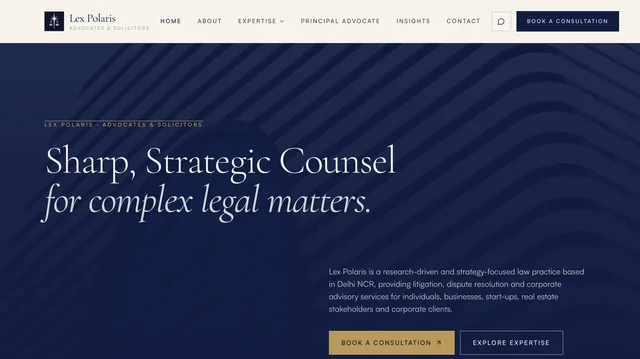
A law firm website we designed and built.

Shown as what the project record says it was. No figure is attached to it, because none is evidenced.

Scope shown per project is taken from that project’s own record. Lex Polaris was a website engagement — it is not shown as a portal, CRM or intake deployment.

What determines the size of this

Two firms with the same headcount can be a very different build.

These are the things that actually move it, in roughly the order they do.

How many practices need their own pageThree practices written properly is a smaller and better project than eleven written thinly.
How many people get a profileProfiles are content work before they are design work, and the firm has to approve every line.
Whether the firm has its contentThe longest part of most law firm websites is waiting for approved text. A firm that already writes moves fast.
Whether anything beyond the website is in scopeA website is one project. Intake, a CRM or a client portal are each their own, and are usually better sequenced after launch.
Seats and languagesMore than one office, or more than one language, multiplies structure and review rather than pages.
What already existsMigrating existing insights and profiles is a different exercise from starting empty, and usually a cheaper one.

Redesign the whole site, or fix the current one?

Fix it, if the structure is right and the problem is presentation — new practice pages and profiles can be added to a site that works. Rebuild when the information architecture itself is the problem: one Services page carrying everything, no route to a practice, an enquiry form that captures nothing. That is a structural fault and no amount of restyling reaches it.

Questions

Law firm questions, answered directly.

What should a modern law firm website include?

A page for each practice the firm wants work in, a profile for each lawyer clients should ask for, an enquiry path shaped by practice rather than one generic form, the firm’s own disclaimers and notices in the structure, and somewhere for the firm’s writing to live. Everything else is optional.

How should a law firm structure its practice-area pages?

One page per practice the firm genuinely wants more of, written to answer that practice’s own questions: what the work involves, how a matter typically proceeds, what the firm needs to see first, and who leads it. Practices the firm does not want more of do not need a page.

Does a law firm need a CRM?

At the point where more than one person is responsible for replying to enquiries. A shared inbox holds messages but cannot hold ownership, practice, stage or source — so a firm using one cannot say what happened to last month’s enquiries. Below that point, a well-structured intake into an inbox is enough.

Does a law firm need a client portal?

It is worth it when the same three questions — where has it reached, what do you need from me, where is that document — are consuming real time. A portal answers those from what the firm has chosen to publish. A firm with a handful of active matters usually does not need one yet.

What can a law firm client portal show?

Whatever the firm decides, and nothing by default: typically the stage of the matter, documents shared in each direction, what is outstanding from the client, and one place to reply. What is published is a decision the firm makes per matter type.

Can a law firm use an AI chatbot?

Yes, if it is scoped to the firm’s published pages and hands anything beyond them to a person. It can explain which practices the firm runs, where it practises and how to reach someone, and it can take an enquiry outside office hours. It must not answer a legal question, assess a matter or present itself as a lawyer.

Can a RAG knowledge base help a law firm?

Once the firm is large enough that the answer exists somewhere and nobody can find it. Retrieval over precedents, templates and internal notes the firm has approved for reuse saves real time for the firm’s own people. It stays internal, it does not draft, and it does not produce advice.

Does Branditify build legal practice-management software?

No. Case management, court diaries, time recording and billing are an established software category with mature products, and for most firms one of those is the right answer. Branditify builds the firm’s digital experience and the enquiry, matter-relationship and client-communication systems around it.

Can an Indian law firm advertise its services online?

Advertising and solicitation by advocates are restricted under the Bar Council of India’s rules. A 2008 amendment permits an advocate to furnish website information — commonly described as name, qualifications, areas of practice and contact details — with intimation to the Bar Council, and the Bar Council has more recently cautioned advocates about promotional activity online. What a particular firm may publish is a matter for the firm and its bar council. Branditify does not advise on those rules and does not certify a site against them.

What happens when a project starts?

A discovery pass over the firm’s practices, people and existing material; an information architecture the firm signs off before anything is designed; content written or restructured and approved by the firm; then design, build and launch. The content approval is the part firms underestimate, so it is scheduled first rather than last.

Next

Start with the enquiry you are already losing.

If you can tell us how a prospective client currently reaches your firm and what happens to that message, we can tell you where it is going and what would change it. That conversation is free and does not need a brief.