
Branditify for wedding planning companies
They already know what you look like. They still cannot tell if you fit.
A couple reaches your website having seen a hundred beautiful weddings, most of them on a listing you pay for. What they cannot get from any of it is whether you handle their kind of wedding, and whether they want you beside them for the next year. Branditify builds the site that answers that, and the systems that hold what happens after it does.
The marketplace sells your photographs. Your own site is the only place the other two questions get answered.
Illustrative interface · sample data
What Branditify actually builds for a wedding planning company
The channel you own, and the systems behind the enquiry.
Two different purchases. One decides whether the right couple ever writes to you directly; the other decides what happens across the year that follows.
Services
What Branditify does for the planning company.
Chosen for what a wedding planning business genuinely needs, and stated with what each one does not cover.
Premium Websites
The listing you pay for already showed them the photographs. They arrive at your site and find the same photographs, so the only thing left to compare on is price.
A site built around wedding cases rather than a feed — format and destination, the functions involved, what your team actually ran and what stayed with the family, and an enquiry that carries enough for a real first call.
A couple can tell whether you have run their kind of wedding before they write.
Usually the largest single piece of work.This is the planning company’s own website. A per-wedding guest site — travel notes, room blocks, RSVP — is a separate build with separate requirements, and it is not this.
Premium WebsitesContent Creatives
The strongest weddings live as camera folders and a shared drive, and the deck a family sees is rebuilt from scratch for every enquiry.
Wedding work turned into presentable assets: case layouts, credentials and proposal visuals that carry the same story in the same language as the site.
The first meeting stops starting from a blank page.
It is the presentation of your work. Décor, styling and on-ground design remain yours.
Content CreativesContent
Every planner page says “we create unforgettable experiences”, so nothing on the site separates one studio from the next.
Written wedding cases, honest format and destination pages, a real description of how you plan, and answers to what a family asks before they will book a call.
The site starts answering questions instead of repeating a mood.
Written from weddings you actually planned. Nothing is invented to fill a page.
ContentSocial Media
A wedding produces more material than the rest of the quarter, it is posted for a week, and then the account goes quiet until the next one.
A content system that treats a wedding as the year it actually is — the recce, the build, the functions, the days themselves, and what the family said afterwards — so the feed shows how you work, not only how the room looked.
Recent work keeps arriving in front of people who are still deciding.
A publishing system. No follower, reach or engagement number is promised.
Social MediaSEO & AEO
Every enquiry comes through a listing or a referral, so the cost of a couple is whatever the platform decides it is this year.
Structure the site around what families actually search — the destination, the wedding format, the planning question they are stuck on — so some of the enquiries arrive without a placement fee attached.
The channel you own starts carrying part of the load.
No ranking position is promised, and this is not a wall of city pages.
SEO & AEOBranding & Identity
The website, the proposal, the deck and the social account each look like a different studio, which is a strange thing for a business selling taste.
One identity system carried across everything a family sees while deciding: site, proposal, presentation, credentials and your own social presence.
The studio looks like one studio at every point of the decision.
This is your company’s brand. Designing an individual couple’s wedding identity, invitations or stationery is separate, scoped work.
Branding & IdentityAlmost nobody needs all of these at once. The usual order is the site that qualifies, then the cases and creative that fill it, then the discovery that brings couples to it directly rather than through somebody else’s listing.
Systems
What the planning company can operate with.
Used where the volume or the way the studio works genuinely calls for them, and left out where it does not.
CRM
Enquiries arrive from a listing, an inbox, a referral and a direct message, and what each family actually wants lives in whoever happened to reply.
One record per enquiry — couple and family, destination, wedding format, functions, stage, owner and next action — with the context attached to it rather than remembered, and the fields your studio actually uses.
Nothing goes quiet for a week because everyone assumed somebody else had replied.
Usually the first system a planning studio needs.It holds the enquiry and the relationship. It is not wedding planning software: it will not run the vendor roster, the production schedule or the payment milestones.
CRMClient Portal
Six people are deciding, the approved version is in one thread and the revised one in another, and nobody can say which mehendi look the mother of the bride actually signed off.
A controlled place for the family — selected files, the options you need a decision on, their requests and the updates you choose to publish. What they see is what you decide they see.
A decision has somewhere to live instead of a timestamp in a group chat.
It is a family-facing surface. It is not a wedding planning system, and it does not run your vendor coordination or your internal schedule.
Client PortalBooking Platform
Getting a first call into the diary takes six messages across two time zones, and a venue recce takes ten.
Bookable slots for the appointments a planning studio actually runs: a discovery call, a planning session, a venue walkthrough, a review before a function.
The first conversation stops being a negotiation about calendars.
This is appointment scheduling. It is not a wedding marketplace, venue inventory, guest room blocks or ticketing — none of which it holds or claims to.
Booking PlatformDashboards
Nobody can answer “which season are we actually filling” without three people opening three files.
Bounded visibility over what the systems already hold — where enquiries came from, which weddings are at which stage, and how the work is spread across the team.
The question gets answered from a screen instead of a meeting.
It reports what is genuinely recorded. It does not invent a number that nothing feeds.
DashboardsA studio taking a handful of weddings a year can hold all of this in a spreadsheet honestly. These earn their place when more than one person is answering enquiries, or when a decision made in October has to be findable in March.
The first problem
Sixty photographs, and only one of the three questions answered.
A couple looking at a planner’s portfolio is asking three things, and the category is unusually clear about what they are. The photographs settle the first one completely. Nothing on a gallery page touches the other two, which are the ones that decide whether you get the call.
One of three, and it is the one the listing had already answered before they arrived.
The same wedding, described so a family can place themselves in it — and so they can tell what working with you would actually be like.
Illustrative. Real cases are written from weddings actually planned — no guest count, budget, satisfaction score or result is added to make an entry look stronger.
What should a wedding planner’s portfolio show?
Enough for a family to place themselves in it. The format and the destination, which functions were involved, how many days the wedding ran, and — the part almost every portfolio leaves out — what your team actually held versus what a design partner, a venue or the family ran. Naming the split is not modesty; it is the only way somebody with a three-day destination wedding can tell you have done a three-day destination wedding. Add one thing that went sideways and how it was handled, and the entry is doing the work the photographs cannot.
The second problem
“Destination wedding in Jaipur. Please share packages.”
It is the enquiry a listing produces, and there is nothing wrong with the family who sent it — they have been given no reason to send anything more. What follows is two weeks of messages establishing things a page could have asked once.
The field list belongs to the studio, not to a template. A planner who only takes full-planning destination weddings asks different questions from one that also does day-of coordination.
What should a wedding planner enquiry form ask?
Enough for an honest first call, and nothing that makes a serious family abandon it. Destination or city, roughly when, the shape of the wedding — how many days and which functions — where the venue conversation has got to, and what they think they need from a planner. That is usually the whole list. Exact budget, final guest count, confirmed venue and a fixed date are the wrong things to demand at first contact: early on a family genuinely does not know them, and asking anyway costs you the enquiry rather than qualifying it. What matters more than the fields is that the answers arrive attached to the enquiry, in the same shape every time, so two families can actually be compared.
The third problem
Five functions, one wedding, and a website that lists them as five events.
A multi-function wedding is not a series of parties that happen to share a guest list. Each function inherits the one before it — who has arrived, what they wore, what is still being set up in the other hall — and that continuity is most of what a planner is actually paid for.
Illustrative programme. It is a drawing of how a planner already thinks about a wedding, not a Branditify product — no wedding app, guest tracking, ticketing or venue booking is implied or sold.
Does a wedding planner need a CRM, and how is it different from wedding planning software?
They cover different halves of the business. A CRM holds the commercial relationship: the enquiry, the family, the destination, the format, the stage, who owns it and what happens next — the part that decides whether a wedding ever becomes yours. Wedding planning software holds delivery: the vendor roster, the schedule, the payment milestones across the year, the run sheets for each function. A studio can be excellent at delivery and still lose weddings quietly at the enquiry stage, because a dropped enquiry leaves no trace and nobody notices the cost. Early on the CRM usually matters more, for exactly that reason.
The fourth problem
Six people are deciding, and none of them is in the same conversation.
A wedding is one of the few purchases where the person paying, the person choosing and the person living with the result are frequently three different people. Every decision is fine on its own. Collectively, “who approved this?” has no answer in March about something settled in October.
Two options held, one decision, and a date after which holding them stops being free.
Waiting on the familySigned off in writing, against the version it applies to.
Signed off by the familyVisible as changed rather than assumed as agreed — the difference that costs a week.
Waiting on the design partnerArrival, stay and movement between the two venues, which is what lets the programme be written.
Waiting on the familyAgreed, which is the point at which the rest of day three can be planned around it.
Signed off by the familyFive decisions, not fifty. A portal that mirrors an entire internal workflow gets ignored; one carrying the handful of things you genuinely need an answer on gets used.
Client Portal or wedding planning software — which one does a planning studio need?
They solve different halves. A client portal is family-facing: selected files, the options you need a decision on, their requests, and the updates you choose to publish — a controlled window rather than a view of everything. Wedding planning software is internal and operational: vendors, schedules, payment milestones, run sheets. Confusing the two produces the two usual failures — handing a family visibility of an internal workflow they were never meant to interpret, or running approvals inside a tool nobody in the family can open. Most studios need the family half solved first, because that is where the disagreements come from.
The destination question
Guests have to get there, stay somewhere and be somewhere. That is hospitality, not travel.
A destination wedding adds a whole category of work that local weddings do not have, and it is the part families ask about most: where everyone stays, how they move between two venues, and who answers the hundred questions that arrive in the fortnight before. It is real planning work — and it is not a travel product.
Guest context, not travel software. Nothing here books flights, holds tickets, tracks vehicles or sells room inventory — a hotel owns its rooms and a tour operator owns the trip. What a planner needs is to know who is where, and when.
What should a destination wedding planner website include?
Everything a local planner’s site needs, plus the things that only matter when guests are travelling: which destinations you actually work in and how often, whether you hold relationships with venues there or arrive fresh, how many days your weddings usually run, and what you take on around the wedding itself — welcome dinners, guest arrival, movement between venues, the departure morning. Families choosing a destination planner are trying to work out how much of the logistics stops being theirs. Answering it plainly does more qualifying than any gallery, and it filters out the enquiries where the answer was always going to be no.
The questions planning studios actually ask
Six decisions, answered without selling you the larger one.
Each of these has an expensive default answer and a correct one, and they are frequently different.
Website, Instagram or Pinterest — where should a wedding planner put the effort?
They do three different jobs and the mistake is asking one to do another’s. Pinterest is where a wedding is imagined, often a year before anybody is ready to enquire, and it rewards work that is beautiful in isolation. Instagram is where a studio is followed and where recent proof lives — the recce, the build, the days, the way you talk. A website is where somebody already interested establishes whether you fit: the formats you run, the destinations you work in, cases with your role named, your process, and a way to send something useful. Search is the only one of the three that reaches a family who does not yet know your name and is not scrolling. The studios that get the most out of all of it are the ones where the same wedding flows through each: the day becomes a post, the post becomes a case, the case answers a search, and the enquiry lands somewhere it can be picked up.
Where this page stops
Three things a wedding touches, and is not.
Wedding planning sits beside several other businesses and borrows their vocabulary freely. Being clear about which one you are reading is not pedantry — it is the difference between a page that answers you and one that sells you somebody else’s problem.
Event Management or Wedding Planning — which page applies?
Ask who is deciding. Wedding planning here means a studio delivering weddings for a couple and their family: functions rather than a programme, hospitality rather than a brief, a decision that is personal and shared across several people, and a relationship that runs for the better part of a year. Event management is the broader company journey — launches, conferences, brand and business events — where the buyer is an organisation, the enquiry is a brief and the decisions move through procurement. Branditify keeps separate Industry pages because the buyers, the language and the searches genuinely differ, not because the work is unrelated. A company doing both is common, and both pages are worth reading.
Relevant capability, described exactly
What Branditify has actually built.
Product surfaces and services Branditify builds, operates and offers — which is a different kind of statement from a client outcome, and is presented as one rather than dressed up as a case study.
CRM
Enquiries, stages, owners and next actions — the opportunity layer this page recommends.
Branditify’s own product capability.
View CRMClient Portal
Controlled family-facing files, options, approvals, requests and updates.
Branditify’s own product capability.
View Client PortalPremium Websites
The service that turns a portfolio into cases a family can place themselves in.
A Branditify service, delivered to scope.
View Premium WebsitesSelected work
A wedding business we have built for.
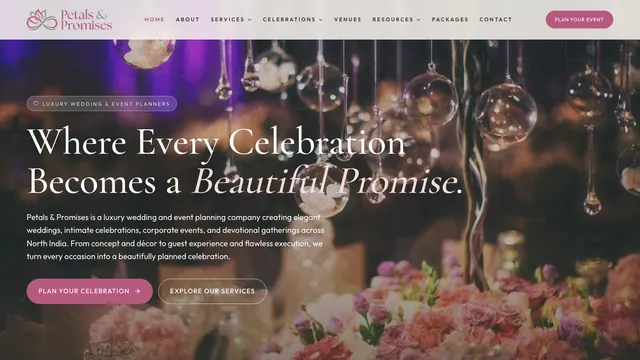
Petals & Promises is an approved case whose own record names this industry — a luxury event website, designed by Branditify.
Questions planning studios actually ask
The rest of it, answered directly.
What should a wedding planner website include?
The formats and destinations you actually work in, wedding cases that name what your team held and what a partner or the family held, an honest description of how you plan across the year, the people a family would be working with, and an enquiry route that captures the shape of the wedding rather than a name and a phone number. The photographs are the reward for reading, not a substitute for it.
How should wedding planners show their portfolio?
As a small number of complete weddings rather than a large number of images. Format, destination, days, functions, your role versus a design partner’s or the family’s, and one thing that had to be solved. A family is trying to place themselves in it, and sixty photographs of three weddings make that harder rather than easier.
What should a wedding planner enquiry form ask?
Destination or city, roughly when, how many days and which functions, where the venue conversation has reached, and what the family thinks it needs from a planner. Asked once, in the same shape every time. Exact budget, final guest count and a confirmed date are usually the wrong things to demand at first contact — early on a family does not know them.
How can wedding planners get better-quality enquiries?
Two changes do most of the work. Make the site say which weddings you actually run and what your role usually is, so families who do not fit stop writing; and ask for the shape of the wedding instead of a message, so the ones who do fit arrive with enough for a real first call.
Does a wedding planner need a CRM?
It becomes genuinely useful once more than one person answers enquiries, or once follow-up across a year depends on somebody remembering. A CRM holds the enquiry, the family, the destination, the format, the stage, the owner and the next action, so nothing goes quiet because everybody assumed somebody else had replied.
CRM or wedding planning software — what is the difference?
A CRM holds the commercial relationship: enquiry, family, destination, format, stage, owner, follow-up. Wedding planning software holds delivery: vendor rosters, schedules, payment milestones, run sheets. They are complementary, and a studio can deliver beautifully while still losing enquiries it never noticed arriving.
Client Portal or wedding planning software?
A client portal is family-facing — selected files, the options you need decided, their requests, the updates you publish. Wedding planning software is internal and operational. Giving a family a view of an internal workflow, or running approvals in a tool nobody in the family can open, are the two usual mistakes.
Is booking software the same as a wedding marketplace?
No. Booking schedules appointments — the discovery call, the venue recce, a review before a function — where the constraint is two calendars. A marketplace lists vendors and sells placement; venue booking holds room and date inventory. Your own diary needs the first; nothing here holds the other two.
Website, Instagram or Pinterest for wedding planners?
All three, doing different jobs. Pinterest is where a wedding is imagined, often long before an enquiry. Instagram is where a studio is followed and where recent proof lives. A website is where somebody already interested works out whether you fit, and search is the only one that reaches a family who does not yet know your name.
Should wedding planners show pricing?
There is no universal rule, because scope genuinely moves the number — destination, number of functions, days, hospitality, your role and creative requirement. What is almost always worth publishing is what drives the scope, what a typical engagement includes and how the planning conversation works. That answers whether a family is in the right place without a figure that will be wrong for most weddings.
What should a destination wedding planner website include?
Everything a local planner’s site needs, plus which destinations you actually work in and how often, whether you hold venue relationships there, how many days your weddings usually run, and what you take on around the wedding — welcome dinners, arrival, movement between venues, the departure morning. Families are working out how much of the logistics stops being theirs.
Event Management or Wedding Planning — which applies?
Wedding planning means a studio delivering weddings for a couple and their family — functions, hospitality, a shared personal decision, a year-long relationship. Event management is the broader company journey, where the buyer is an organisation and the enquiry is a brief. Branditify keeps separate pages because the buyers and searches differ; a company doing both should read both.
Does a wedding planner need a mobile app?
The studio itself almost never does — the team already works from phones on existing tools, and an internal app is a second product to maintain. A guest-facing app belongs to one specific wedding at a scale that justifies it, commissioned as part of that wedding rather than built as a permanent asset.
Can consultations and venue walkthroughs be booked online?
Yes, and it is one of the smaller changes with an immediate effect. Bookable slots for a discovery call, a planning session or a venue recce remove the six-message negotiation that currently sits in front of every first conversation, which matters more when the family is in another time zone.
Can family approvals and files be managed digitally?
Yes, through a client portal holding the options you need decided, the current version of each file, the family’s requests and the updates you publish. The value is not storage — it is that in March somebody can answer what was approved in October, and against which version.
Can existing enquiry and client data move from spreadsheets?
Usually. Spreadsheets, inboxes and most tools export cleanly, and enquiries, families and wedding history transfer. The part that does not is whatever was never written down. A migration is a good moment to decide what the studio actually needs to remember.
Can wedding planners manage destination guest context digitally?
The planning part, yes — which guest groups arrive when, where they are staying, which function they join first and what the studio owes them on arrival. That is hospitality context. Booking flights, holding tickets, tracking vehicles and selling room inventory are different businesses, and nothing described here does them.
When does custom wedding planning software make sense?
Later than most people are told. A CRM for the enquiry, a client portal for family approvals and an ordinary project tool for delivery covers a great many studios completely. Custom software starts to earn itself when the process itself is the problem: approvals that must move in a set order across several families, vendor coordination no standard tool expresses, or a workflow the team has already broken twice by working around it.
Who owns the website, systems and data after the build?
The planning company — code, content, family records and accounts in its own name, on infrastructure it controls, with no dependency on Branditify to keep running. It matters especially for a studio that already rents its enquiry channel.
What determines the scope of a wedding-planner digital project?
How much of the business the site has to carry, how many weddings and enquiries flow through it, whether more than one person answers, whether families need a place to decide things, and whether destination work adds guest context to hold. Not the number of pages.
What should a wedding planning company digitise first?
Whatever is currently losing weddings. For most studios that is the enquiry — a site that says which weddings you run and a form that captures the shape of one. Family approvals come next, once decisions are worth being able to find. Custom workflow comes last, and only when the process itself is what is broken.
If this is the studio you are running
Start with one wedding you have already planned.
The first conversation is usually about a single past wedding: what the family wanted, which functions you actually held, what a partner or the family ran, and what somebody planning a similar wedding would need to see to recognise their own in it. That is normally enough to know what the site should carry and what to build first.