Branditify for AI startups
The demo works. Nobody can tell you what the product does.
A founder shows something genuinely impressive in twenty minutes, and the homepage says “AI-powered platform for modern teams”. Branditify turns the behaviour into a product a buyer can understand — who it is for, what it receives, what it answers with, and what a person still decides.
Building a working agent is easy now. Building one somebody will deploy, trust and pay for is the actual problem.
Illustrative interface · sample data
What Branditify actually builds
The build, and the systems the product runs on.
Most founders arrive with a behaviour that works and a product that does not exist yet. These are the two halves of closing that gap.
Services
From a behaviour that works to a product somebody buys.
Chosen for what an AI startup genuinely needs, and stated with what each one does not cover.
MVP & SaaS Development
The model call works. There is no account, no history, no permissions, no way to see what it did yesterday, and nothing a customer could be given access to.
The product around the behaviour — user and account flow, state and history, permissions, the review surface, error and fallback states, an admin view, and a deployment a team can actually run.
The founder stops demonstrating a script and starts demonstrating a product.
Usually the largest single piece of work.Scope follows the use case. Not every product needs billing, roles or an audit trail, and none of those is added because it sounds thorough.
MVP & SaaS DevelopmentAI Strategy
The roadmap says “add AI” in four places and nobody can say which of them a customer would pay for.
Which behaviour is actually worth building, what it needs to see, where a deterministic workflow would be better and cheaper, and what has to be evaluated before anyone relies on it.
The build starts from a decision rather than a feeling.
This is product scoping for a specific AI behaviour. It is not general startup consulting, and it is not a fundraising exercise.
AI StrategyAI Agents & Automation
“Agentic” is on the site, and nobody has decided what the thing is allowed to touch.
Bounded behaviour — the tools it may call, the permissions it holds, what it must ask before doing, and what happens when a step fails or a source is missing.
The agent has edges, which is the only version anybody deploys.
Bounded and reviewable by design. No claim of unsupervised autonomy, and no promise that a model will not be wrong.
AI Agents & AutomationPremium Websites
The product is obvious in the demo and invisible on the homepage, which says it is transforming the future of something.
The same contract the product runs on, written for a buyer — who it is for, what it takes in, what it gives back, what a person still decides, and one honest reason to book a conversation.
A stranger can understand in forty seconds what took the founder twenty minutes.
SEO & AEO
The category name is contested, the product is new, and the site is optimised for a word buyers do not search.
The use case, the comparison a buyer actually makes, and the questions asked before a demo — written as pages that can be found and quoted.
Demand that already exists finds the product.
Almost nobody needs all of these at once. The usual order is deciding the behaviour, building the product around it, then explaining it well enough that a demo is worth booking.
Systems
Capabilities the product can be built on.
Used where the product genuinely needs them, and left out where it does not.
RAG Knowledge Base
The answers are fluent and nobody can tell where any of them came from, which is the first thing a buyer asks.
Approved sources, retrieval scoped to them, and the passage shown beside the answer so a reviewer can check it in a second rather than a minute.
An answer arrives with its evidence attached.
Only where the product answers from a body of knowledge. Plenty of AI products do not.It grounds answers in chosen sources. It does not make a model correct, and no accuracy figure is claimed for it.
RAG Knowledge BaseAI Chatbot
The interface is a text box with no edges, and every question looks answerable.
A bounded conversation with a stated scope and a clean handover the moment a question leaves it.
The product stops pretending to know things it was never given.
A conversation surface, not the product architecture. Many AI products should not be a chat interface at all.
AI ChatbotCRM
Demo requests come from the site, a founder’s inbox and a conference badge, and the objections raised in each stay in whoever’s memory took the call.
One record per request — source, use case, stage, owner, next action — and the objection written down where the product team can read it.
What buyers keep asking for stops being anecdotal.
It holds the opportunity and the follow-up. It is not product analytics and it is not a data warehouse.
CRMProviders and models are chosen around the behaviour, the data, the latency and the controls the product actually needs — not the other way round, and no provider relationship is claimed here.
The first problem
“AI-powered” is not a product description.
The words on most AI startup homepages — powered, intelligent, agentic, next-generation — are not wrong. They are simply not information, and a buyer comparing three products has nothing to compare. The fix is not better adjectives. It is stating what the thing actually does.
How should an AI startup explain what its product actually does?
By saying what “powered” means operationally: who uses it, what it receives, what it is allowed to look at, what it gives back, and what a person still decides. Five sentences. A buyer who can repeat those five to a colleague can champion the product internally; one who only has “AI-powered platform” cannot, and that is usually where a promising demo quietly dies. It also happens to be what makes a product legible to search and to the answer engines buyers increasingly ask first.
The second problem, and the one that stops deals
A working agent is easy. A deployable one is not.
The gap between a behaviour that works on a laptop and a product somebody will run against their own customers is where most AI startups actually get stuck. It is rarely the model. It is everything the model does not do.
Every layer below is scoped to the product in front of us. No certification, compliance status or accuracy figure is claimed anywhere on this page, because none can be honestly promised in advance.
How do you turn an AI demo into a product people will actually deploy?
By deciding what happens in the cases a demo never shows. What it does when there is no relevant source; what it is allowed to touch and what it must ask about first; who reviews an output before it reaches a customer; what gets recorded so a mistake can be traced; and what happens when a provider is slow or down. None of that is glamorous and all of it is what a buyer’s security and operations people ask about in week two. A product that has answers moves forward; one that has adjectives does not.
The third problem
The founder explains it perfectly. The website does not.
Almost every founder can make the product obvious in a live conversation. Almost no early AI website manages the same thing, because the page was written to sound impressive to everyone rather than clear to one person.
Website or product demo for an AI startup?
The website’s job is to earn the demo, not to replace it. That means it has to do the one thing a demo cannot do at scale: let a stranger self-qualify at two in the morning. Name the user, the input, the sources, the output and the human control, show one honest example, and make the next step a conversation rather than a signup. A site that tries to be the product usually convinces nobody, and a site that says nothing gets no demos to convert.
One possible setup
From a decided behaviour to a demo somebody books.
One arrangement that works, not a package. Most of these steps already exist in a startup; the change is that they stop being separate accidents.
The chatbot surface, the agent boundaries and search work are added where the product earns them. A startup with three design partners may need none of them yet.
What should an AI startup build first?
The decision, then the product, then the explanation. Deciding the behaviour costs days and saves months, because it determines what has to be built at all. The product comes next, scoped to that behaviour rather than to a feature list. The public explanation comes third and is usually the piece founders leave longest — which is why so many technically strong AI startups have a homepage that could belong to any of two hundred companies.
The questions founders actually ask
Six decisions, answered without selling you the bigger one.
Each of these gets answered upwards in this category. The honest answer is often the smaller build.
RAG, a chatbot, or an agent — which does the product need?
They are not alternatives, they are different layers, and conflating them is the most common scoping error here. RAG is how a system finds approved knowledge to answer from. A chatbot is one interface a product might use, and often the wrong one — plenty of AI products are better as a button inside an existing tool. An agent is a system permitted to take bounded steps using tools, which raises questions about permissions and approval that a retrieval system does not. A product can use all three, one, or none.
Relevant capability, described exactly
What Branditify has actually built.
The honest answer for a category this new is capability rather than a startup logo wall. These are Branditify’s own product surfaces — built, documented and in use as offers, which is a different kind of statement from a client outcome and is presented as one.
RAG Knowledge Base
A retrieval layer that answers from chosen sources and shows the passage beside the answer.
Branditify’s own product capability.
View RAG Knowledge BaseAI Chatbot
A bounded conversation surface with a stated scope and a handover when a question leaves it.
Branditify’s own product capability.
View AI ChatbotAI Agents & Automation
Bounded agent and workflow implementation — tools, permissions, approval and failure behaviour.
A Branditify service, delivered to scope.
View AI Agents & AutomationSelected work
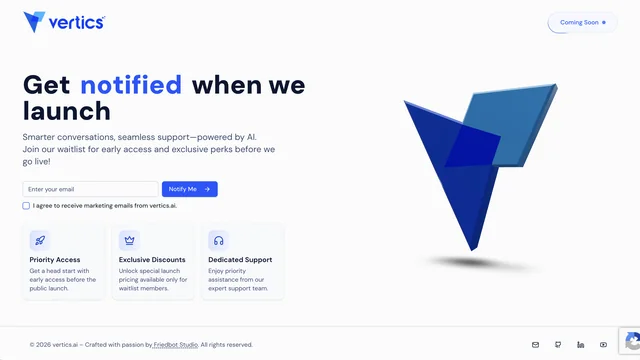
An AI startup we have worked with.
Vertics is an approved case whose own record names this industry — identity and launch-page design for an AI startup.
Questions founders actually ask
The rest of it, answered directly.
What should an AI startup website include?
The five statements the product runs on — who uses it, what it receives, what sources it may use, what it returns, and what a person still decides — plus one honest example, the objections a buyer will raise anyway, and a next step that is a conversation rather than a signup.
What is the difference between an AI prototype and an MVP?
A prototype answers whether the behaviour is possible or useful and can live in a notebook. An MVP puts a bounded version in front of real users with enough product structure — accounts, history, permissions, review, fallback — to learn from them safely.
How do you turn an AI demo into a usable product?
By deciding what happens in the cases a demo never shows: no relevant source, an action with consequences, a provider that is slow or down, an output nobody checked. Building a working behaviour is the easy half now; making it deployable is the half that takes the time.
RAG vs chatbot vs AI agent — what is the difference?
RAG is how a system finds approved knowledge to answer from. A chatbot is one possible interface, and often the wrong one. An agent is permitted to take bounded steps using tools, which raises permission and approval questions retrieval does not. A product may use all three, one, or none.
AI agent or normal workflow automation?
If the rules are clear and the input is structured, deterministic automation is cheaper, faster, testable and predictable. AI earns its place where language is messy, inputs are unstructured, or interpretation genuinely helps. Choosing AI where a rule would do is the most expensive mistake in this category.
Does every AI product need RAG?
No. Retrieval matters when the product answers from a body of knowledge somebody owns. If the value is transforming, extracting or drafting from what the user already provides, RAG adds cost and latency without adding correctness.
How can an AI startup make its product easier to trust?
By making the controls part of the product rather than a paragraph beneath it: answers that show their source, a stated list of what the system may touch, a person who approves anything consequential, an explicit pause when there is no basis to answer, and a trace that explains a past output. No page can promise correctness, and one that does is the least trustworthy of all.
Should AI outputs require human approval?
Wherever the output leaves the company, costs money, or would be embarrassing to get wrong — which in early products is most places. Review is not a limitation to be engineered away; it is usually the thing that makes a buyer willing to deploy at all.
AI startup or SaaS startup — what is the difference?
In an AI startup the AI behaviour is what the buyer is purchasing, so the product decisions and the trust questions are about sources, bounds and review. In a SaaS startup the buyer purchases a software workflow and AI may be absent or incidental. A company can be both, but the questions it has to answer differ enough to be worth separating.
Custom AI product or off-the-shelf AI tooling?
Off-the-shelf until a specific constraint makes it wrong — the workflow is genuinely yours, the data cannot leave, the cost at volume stops working, or the behaviour is the product itself. If the tool is the product, buying it is not an option; if the tool merely supports the team, building it is usually a distraction.
When should a startup build instead of using a model provider?
When a named constraint forces it: cost at real volume, latency, data residency, or a behaviour no general model handles well. Before that, provider APIs are the cheaper path and the runway is better spent on the product. Providers are chosen around the behaviour, data, latency and controls a product needs.
Does an AI startup need a mobile app?
Usually not at the start. Most early AI products are used at a desk, and an install between the buyer and the product costs more than it earns. It becomes reasonable when the behaviour genuinely belongs on a phone.
When should an AI startup invest in SEO?
Once the product has a use case that can be named. Before then there is nothing specific to rank for, and generic category terms in a contested new category are an expensive place to learn. Afterwards, the use case, the comparison and the objection are the three things worth writing.
Website or product demo for an AI startup?
Both, doing different jobs. The website earns the demo by letting a stranger self-qualify without a call. The demo closes. A site that tries to replace the demo usually convinces nobody, and a vague site produces no demos to convert.
Can an existing prototype be turned into a production product?
Often, where the work is recoverable — the prompts, the evaluation examples and the logic usually carry forward even when the surrounding code does not. What rarely survives is anything that only ever worked on one laptop.
Can existing data and knowledge sources be connected?
It depends what they expose. Document stores, help centres and databases usually connect directly; some systems need an integration layer; a few are honestly a manual export. Worth establishing before a contract rather than after.
Who owns the product, code and data after a custom build?
The startup does — code, data, prompts, evaluations and accounts in its own name, on infrastructure it controls, with no dependency on Branditify to keep running.
What determines the scope of an AI MVP?
The behaviour being built, what it must see, who reviews its output, and what has to be true before real users touch it. Not a feature count — and adding permissions, billing or an audit trail that the use case does not need is the fastest way to make an MVP stop being minimal.
If this is the product you are building
Start with the sentence the product has to make true.
The first conversation is usually about one behaviour: who it is for, what it sees, what it returns and what a person still decides. That is normally enough to see what to build first and what to leave out.